

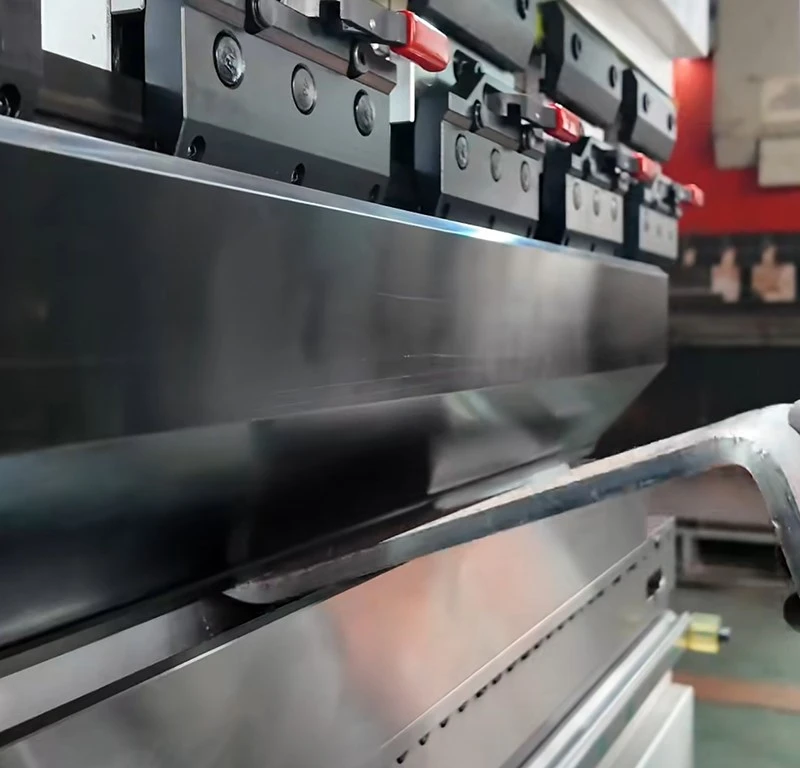
I. The Myth of Model Selection for Thick and Short Plates
In sheet metal fabrication, the bending of 10mm thick short plates often falls into a selection trap: many enterprises default to large-tonnage, long-bed models, resulting in multiple wastes of equipment investment, floor space, and energy consumption.
In reality, the tonnage required for bending short plates is much lower than that for long plates. Taking a 10mm low-carbon steel plate with a V70 lower die as an example, only about 9-10 tons of force is needed per meter of bending. Even when bending a 500mm long short plate, the required tonnage is less than 5 tons. Configuring a 100-ton or larger long-bed model for this purpose means extremely low bed utilization, a typical case of "using a sledgehammer to crack a nut."
How to complete thick plate short-piece processing with a suitable model is a focus for many factories looking to reduce costs and increase efficiency.
II. Test Machine: 55-Ton Compact Pump-Controlled Press Brake
The test equipment for this session is the WE67K-55T/1250 high-speed pump-controlled servo press brake independently developed by WuJia Machine Tool.
The machine has a nominal pressure of 55 tons and an effective bending length of 1250mm, focusing on the processing of short-sized workpieces. The whole machine body is compact and occupies a small footprint, making it suitable as supplementary capacity equipment in the workshop or dedicated to the processing of short and thick plates. The core configuration is a high-speed pump-controlled servo system, paired with a high-rigidity welded frame.
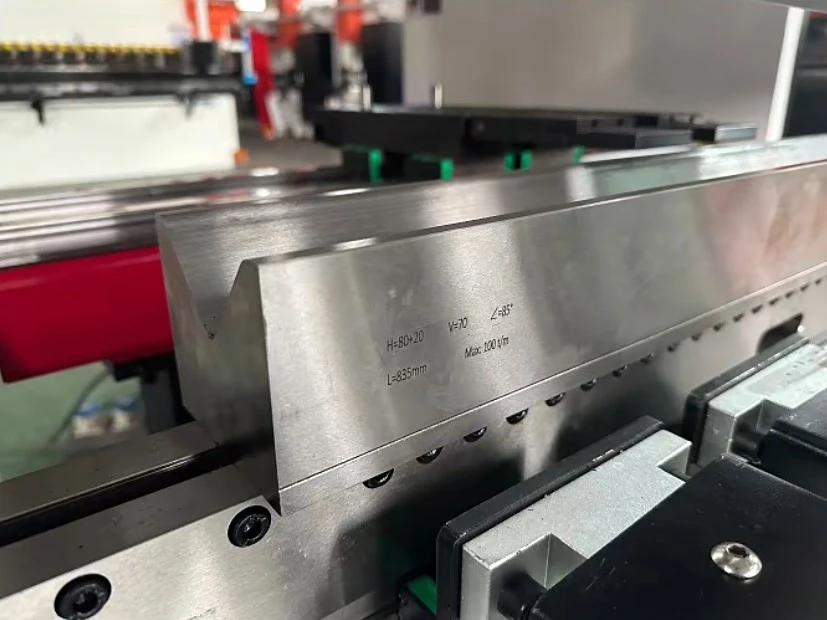
III. Test Process: Bending 10mm×300mm Short Plate with V70 Die
The test used a V70 specification lower die slot to bend a 10mm thick, 300mm long short steel plate. According to process calculations, the required bending force for this specification is only about 3 tons, leaving the 55-ton machine with ample capacity in reserve.
On-site footage shows that the slider descends smoothly, the pressure remains stable during the holding stage, and there is no noticeable vibration of the whole machine. The formed workpiece has straight flanges and uniform angles, meeting the forming effect standards. The pressure output of the pump-controlled system is smooth, without the jerky feeling of traditional valve-controlled models. The single bending cycle is smooth, and the forming quality of the thick plate is stable.
IV. Capacity Support: Pump Control Technology Makes Small Machines More Efficient
The 55-ton model easily handles 10mm thick short plates, with the core being precise selection matching-short plates themselves require little force, eliminating the need to blindly pursue large tonnage.
The addition of pump-controlled servo technology gives this "small but mighty" machine more advantages in actual combat: the servo motor directly drives the oil pump to adjust flow and pressure on demand, with no overflow loss and significant energy-saving effects; fast response speed makes the bending cycle more efficient; small oil temperature fluctuations ensure stable precision during long-term continuous production. Combined with a high-rigidity welded frame, the force transmission during short plate bending is direct and efficient, making the whole machine run more reliably.
V. Selection Insights: Precise Selection Is More Cost-Effective Than Blindly Choosing Large
This on-site test provides a new idea for sheet metal selection: thicker plate bending does not mean higher tonnage is better; it is necessary to accurately match the model based on workpiece length and material thickness.
For scenarios dominated by short and thick plate processing, a 55-ton class pump-controlled servo press brake can fully meet the demand. This type of "small but mighty" model has low investment, small footprint, and energy savings, offering obvious cost-effectiveness advantages for dedicated processing. With the popularization of pump control technology, the processing boundaries of small-tonnage models continue to expand, and equipment selection that accurately matches the scenario will become an important direction for enterprises to reduce costs and increase efficiency.